

Football drones should not be confused with modified aerial photography drones. They are specialized models developed specifically for competitive matches.
A key distinguishing feature is their fully enclosed spherical protective frame, which resembles a floating football. This frame serves a dual purpose: it protects the internal precision components and prevents damage caused by collisions, making it the most intuitive difference between football drones and conventional drones.
Designed to meet the competitive requirements of speed, stability and agility, football drones consist of four core components: the fuselage, multiple sets of small propellers, flight control chips, and batteries. With no redundant structures, they ensure smooth and precise aerial control performance.
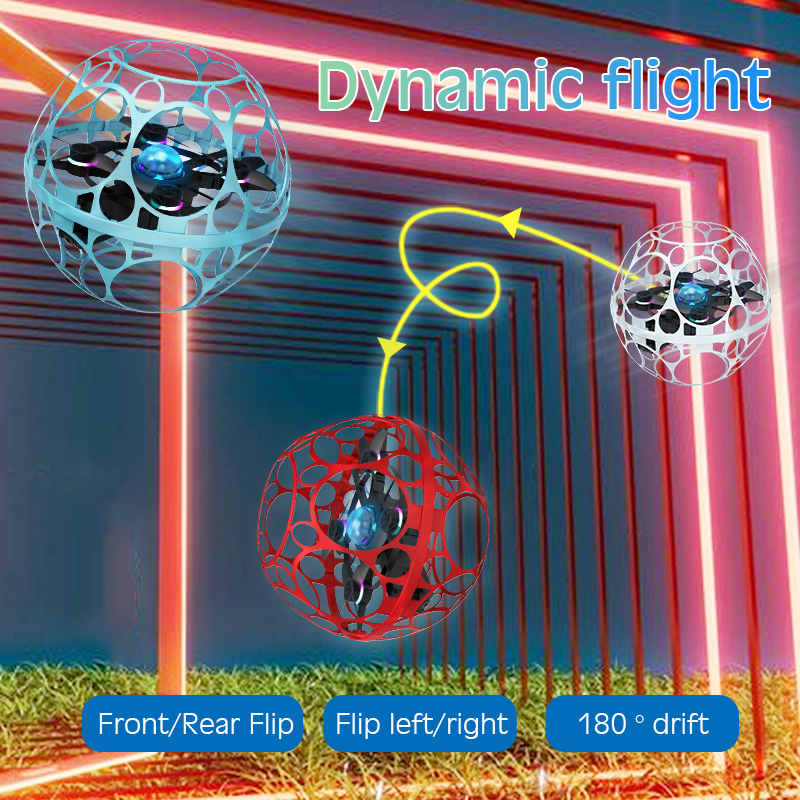
There are clear specifications for the size and weight of football drones based on match categories. For 5-a-side matches, the total flight weight of the drone shall not exceed 1200 grams, with a frame diameter of approximately 400 millimeters. For 3-a-side matches, the drone is more compact, with a total weight not exceeding 300 grams and a frame diameter of about 200 millimeters. All components must be installed inside the spherical frame to ensure the fairness and safety of the competition.
The flight principle of football drones is relatively straightforward. It essentially relies on Newton’s Third Law of Motion, which states that for every action, there is an equal and opposite reaction. When the propellers rotate at high speed, they push air downward, and the air in turn exerts an upward reaction force, known as lift. When the lift exceeds the drone’s own gravity, the drone takes off; when the lift balances the gravity, the drone achieves hovering, which is the most common flight state during matches. The flexible movement of the drone is realized by adjusting the speed difference of the propellers. The flight control system precisely adjusts the rotation speed of each propeller at the millisecond level, enabling movements such as forward and backward movement, left and right steering, and 360-degree rolling.